Half the disputes on a confirmed booking start with a word rather than a number. The client read "double room" and pictured two beds; the hotel read it and blocked one. Nobody was lying — the words mean different things in different parts of the trade, and a quotation is where they have to be pinned down.
Twin sharing
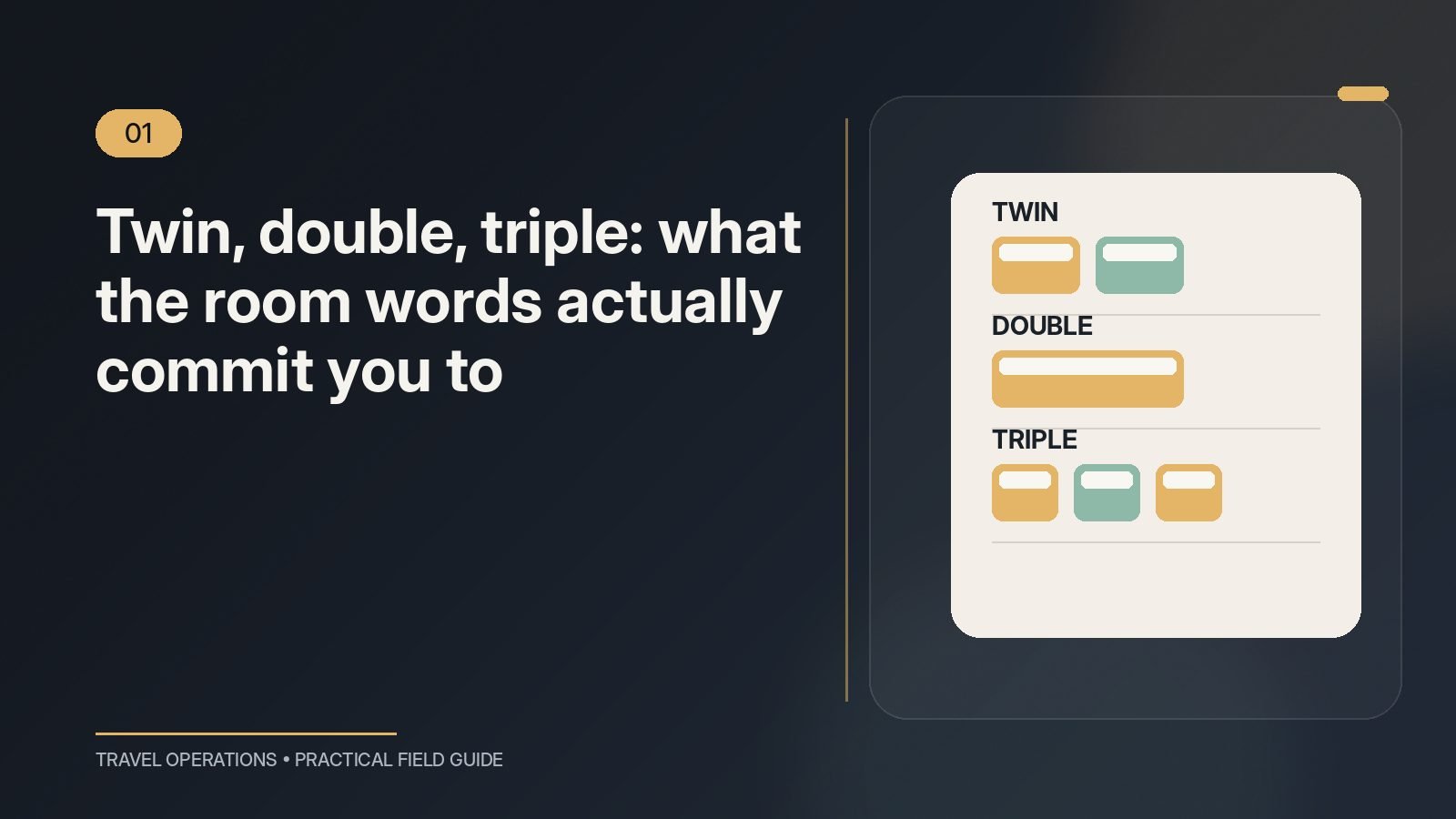
Two people in one room, and the price is per person. This is the default unit of a B2B tour quotation, and the source of the most expensive misunderstanding in this list: a per-person figure quoted without the words "on twin sharing" beside it will be read as the price for the room.
Double room
A room with one bed for two people. A twin room has two beds for the same two people. Both are "two adults" to your costing and both are usually the same rate, but they are not the same room to the couple who booked it or to the two colleagues who did.
Single occupancy
One person in a room built for two, at close to the twin-sharing room rate rather than half of it — which is why a single supplement exists. Quote the supplement as its own line rather than folding it into a higher per-person price; a solo traveller who can see the supplement will accept it, and one who only sees an inflated headline number will shop around.
Triple sharing
Three people in a room meant for two, with an extra bed rolled in. Two things follow from that and both belong in writing: the third bed is charged at the hotel's extra-bed rate, and the room does not get bigger. A family that pictures three full beds and finds a folding one has a complaint you could have prevented with six words.
Child with bed, child without bed
Two different rates, and the age bracket that separates a child from an adult belongs to the hotel's contract, not to your judgement. "Child" is a range on a rate sheet — often 5 to 11, with under-fives complimentary and twelve upward charged as an adult. Ask for the ages at enquiry time and quote them back in the document.
Extra bed, and what it is not
An extra bed is a rate on the contract. It is not a percentage of the room rate, however convenient that would be, and it is not the same for an adult and a child. Two of the three lines on any family quotation are extra-bed lines, so this is worth getting exactly right.
EP, CP, MAP, AP
- EP — room only.
- CP — room with breakfast.
- MAP — room with breakfast and one other meal, usually dinner.
- AP — all three meals.
These are four different rates for the same room, not one rate with a note attached. If the plan changes along a route — CP in the city, MAP at the hill stops where there is nowhere else to eat — say where it changes.
Write the assumption next to the number
Every one of these words costs money when it is assumed rather than stated. The fix is a single line under the price: per person on twin sharing, MAP, one child under five without a bed. It takes ten seconds and it removes the entire category of argument that begins "but I thought that included…".
The rest of the lines a quotation needs are in what a travel quotation must include, and how the room plan drives the price is in quoting the same trip for two, four and six travellers.
Common questions
What does triple sharing mean?
Triple sharing means three people sharing one room. In practice that is usually a double or twin bed plus a third bed — a rollaway, a mattress or a sofa bed — and which of the three you get is a question worth asking, because a mattress on the floor and a proper extra bed are the same word on a rate sheet and a different experience in the room.
Per person it is the cheapest way for three adults to travel, because one room is being shared three ways instead of two.
What is the difference between a twin and a double room?
A double has one large bed for two people. A twin has two separate single beds for two people. The occupancy is identical and the rate is often identical, which is why the two words get used interchangeably — but the room is not the same, and for two colleagues travelling together or two friends it is the only detail that matters.
Always state which one you have quoted. "Double or twin, subject to availability" is honest and prevents the argument at check-in.
What is a single supplement?
The extra amount one person pays to have a room to themselves. Hotel rooms are priced per room, not per head, so a solo traveller occupying a double is still using a double — the supplement is the difference between half that room and all of it.
It is not a penalty and it is not a mark-up. It is the same room cost, divided by one instead of two.
Do children need their own bed, and what does it cost?
Hotels price children three ways: sharing the parents' bed with no extra bed at all, sharing the room with an extra bed, and occupying a room of their own. Each has a different rate, and each hotel draws the age lines in a different place — typically one boundary somewhere around five and another around eleven, but the contract is what decides it, not the convention.
Quote the ages, not the number of children. "Two children" is not a price; "one aged four without a bed, one aged nine with a bed" is.
What do EP, CP, MAP and AP mean on a hotel rate?
They are meal plans. EP is room only. CP is room with breakfast. MAP is room with breakfast and one other meal, normally dinner. AP is room with all meals.
They change the rate substantially, they can differ night by night within one trip, and a quotation that does not name the plan has not stated what the traveller is buying.
Stop rebuilding the same quotation.
One rate card, one branded document, sent in minutes instead of an afternoon.
See what it does